Text description provided by the architects
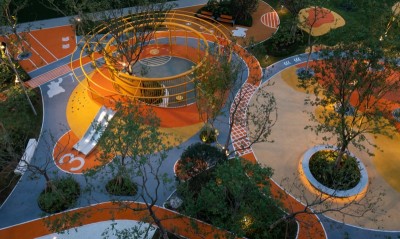
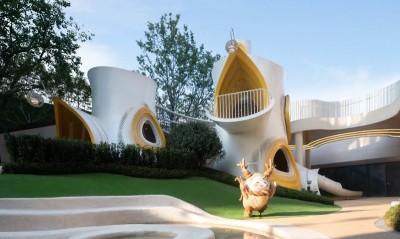
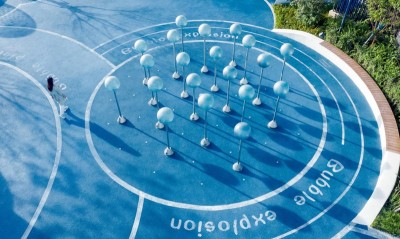
Designed by HID Landscape, the Shui Meng Qi Yuan renewal transforms an ageing indoor hot-spring water park on the northern extension of Beijing's central axis, at Yangshan in Changping District, into a micro-vacation destination. The original Wen Du Shui Cheng opened nearly twenty years earlier and once hosted major CCTV talent shows, but after 2013 lost its audience to streaming media and a wave of lookalike competitors; by the time the team first visited in late 2019, visitors were few and mostly elderly locals. The client set the direction: a holiday destination combining large hot-spring water rides, children's non-motorised play, smaller kids' attractions and hot-spring wellness, eventually also serving as a training base for off-road activities at the foot of Yangshan, targeting Beijing's post-1980s new-middle-class families and post-1990s outdoor enthusiasts. Rather than retrofitting a conventional theme park, the team built a story. They settled on three qualities, surprise, vacation and high visual appeal, and on a myth drawn from local geology: in the turbulent ages of the Yanshan, thermal springs burst from the mountains and gathered into the Wenyu River, creating a hot-spring archipelago where mythical beasts from the Shan Hai Jing once moved. The design follows the principle of light plot, heavy spatial experience and light packaging, heavy art, producing a parallel world built from four motifs: island contours, sprite colours, sprite boxes and Shan Hai Jing art installations. Ribbon-like folding curves define space, route movement and sightlines while echoing island geography; a candy-colour palette gives the world its playful, youthful tone; perforated metal 'sprite boxes' sit between the islands, their layered mesh producing hazy gradients; and large installations, including an ice-wall backdrop, the rib cage of a mythic snake and a giant kun fish soaring overhead, fill the hall. The 45,000-square-metre project, designed from January to December 2020 and completed in July 2021, is an integrated landscape-architecture-interior work in which every device, scene and rest space is embedded after operational analysis. The team's three greatest challenges were the enclosed interior boundaries, the messy realities of retrofitting an existing building, and the engineering of large-scale art installations, but the result is a dreamlike winter-and-summer world for north Beijing.




 Editor's Pick