Text description provided by the architects
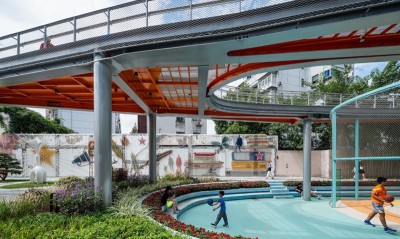
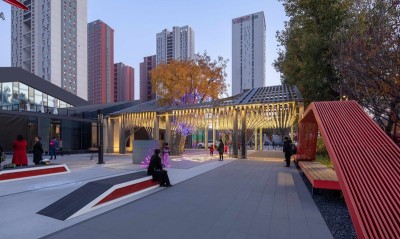
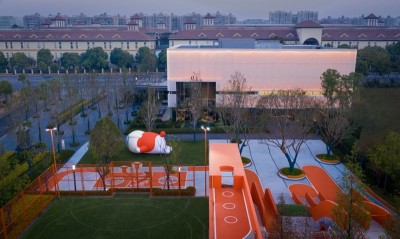
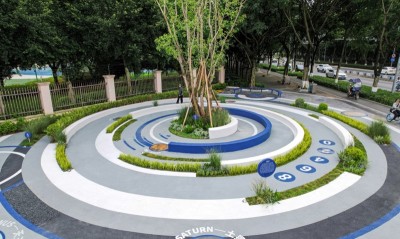
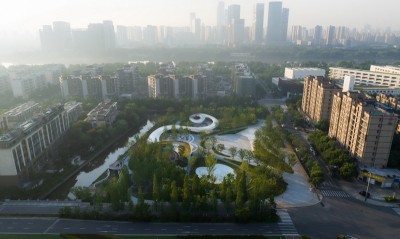
Yunji Park sits on the middle section of Yunji Road in Xiling District, Yichang, within a 30-to-60-meter boundary strip of the south entrance to Yichang Children's Park, directly facing the Taohualing State Guesthouse across the road. The project carries multiple identities at once: it is a pocket garden within the Yunji Road urban renewal, the southern edge of the Children's Park and a major visual counterpart to the guesthouse. The original park, founded in 1956 as Xiling Park and renamed Children's Park in 1986, was enclosed by an iron fence typical of mid-twentieth-century management, and removing the wall to reveal green was the obvious first move, but the team had to redesign entry circulation, integrate it with internal paths and use the space more efficiently. A vast stock of mature trees, some two to three people wide, and the natural grade change from Dongshan Hill toward the Yangtze, give the site rich spatial variation, and the design had to ask how these half-century witnesses could rejoin civic life. As the only large open space on the 1.5-kilometer Yunji Road, it also had to express the district's modernity, vitality and fashion. The design strategy, by HID Handi Landscape and built by Hubei Guangsheng Construction Group for the Yichang Urban Construction Project Management Center, pursues three moves. First, a soft boundary activates city life: after removing the wall, the sidewalk and park edge are blurred so that urban slow paths and green public space interpenetrate into a soft, transparent, inclusive civic open space with strong identity for both the road and the guesthouse opposite. Second, flowing space: opening the boundary means more than demolition, it lets people reach the interior quickly, and flowing lines link inner and outer surfaces, opening a comfortable sunken understory space and dissolving grade changes into garden paths, terraced gardens and event plazas. Third, listening to the great trees: fifty years of urban weather have grown a forest, and each tree is reorganized, either as a terraced tree array, a solitary lawn specimen, a terraced garden or a background boundary. The site divides into four spaces, each generated by and centered on a tree: Luanshu Garden retains and thins a strip of golden rain trees along the boundary, with free seating under the canopy and translucent concrete details; the Stepped Garden exploits the road's steepening grade, seating existing osmanthus into terraced planters as if they had always been there, with star-bridge benches and a glowing YUNJI sign; the Great Tree Gathering opens the root zone of a 90-centimeter-camphor whose roots sat a meter below grade, a relic of the park's conversion, turning it into a sunken, multi-use event grove where residents play bridge and continue their daily rituals; and the Time Lawn clears poor mixed shrubs into a clean lawn that catches views from Taohualing, with light, flowing subspaces under retained trees. Designed in June to August 2022 and completed in October 2022 over 15,000 square meters as a fast EPC project, the park has become the ground on which runners, morning exercisers, office workers, parents, card players, square-dance teams, readers, children and students all find their place.




 Editor's Pick
 Latest Design