Text description provided by the architects
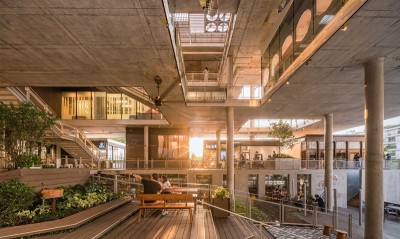
Imagine a metropolis of fifteen million people and eight million registered vehicles with no decent public sidewalks at all. That is precisely the condition of Bangkok, where over two million visitors add daily to a dense urban fabric in which every inch of ground has become a transactional surface. Street vendors occupy more than half of pedestrian space, and a tangle of legal and illegal signage further blocks the walkways, in places forcing pedestrians into vehicle lanes and raising accident rates. In 2012 the client CPN commissioned a two-storey Groove retail centre atop a parking structure on Ratchaprasong, between the city's two busiest railway stations, a location that generates enormous pedestrian flows yet sat above a gloomy sunken void. The existing structure, five metres below the sidewalk, had been planted with tall royal palms whose shade made the undercroft feel unsafe and was partly given over to motorcycle parking, producing a crime-prone dead zone. The brief originally called for an interior courtyard that would act as an urban focal point, but the landscape team argued that the more urgent task was to redesign the public realm outside. The transplanted palms let sunlight reach the ground, and a two-metre linear sloping landscape now conceals the ventilation void and prevents falls while introducing native shrubs and flowering perennials that bloom across the seasons. The sloping planting lowers ground-level temperatures and, together with a new drainage system that harvests runoff for irrigation, keeps the walkway dry and comfortable. Motorcycle parking was removed, the entire area was returned to a flat, accessible pedestrian surface including wheelchair users, and every existing street tree was retained for summer shade. Where pedestrians formerly crossed the block only through a bleak enclosed steel footbridge beneath the rail tracks, the new landscape encourages ground-level walking among the gardens, fostering contact with nature and with one another. Completed in 2012 by a team including A49, FOS and SDA, the project treats a small stretch of Bangkok sidewalk as a civic prototype: drivers passing now see greenery rather than congestion, visitors stop to photograph the scene, and occasional community gatherings animate the space. The designers believe that if neighbouring landowners follow suit, the city can begin to build a coherent pedestrian network for all its residents.




 Editor's Pick
 Latest Design