Text description provided by the architects
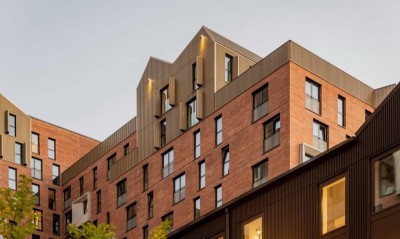
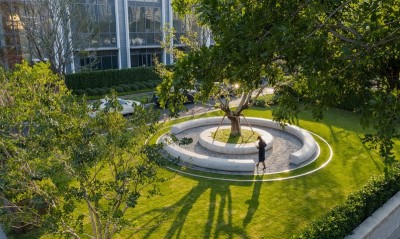
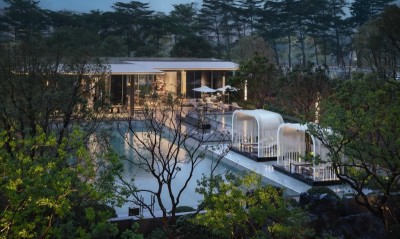
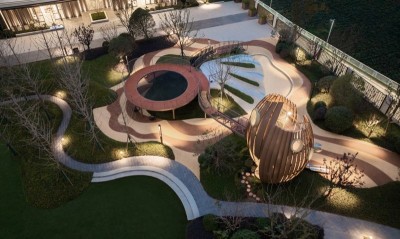
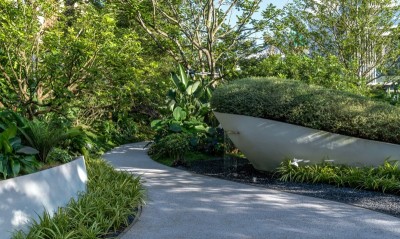
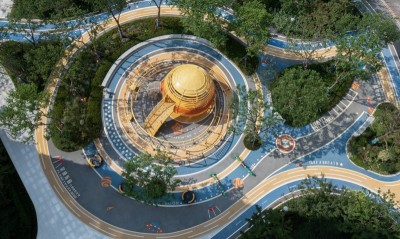
Developed by China Overseas Real Estate in Fangshan, Beijing, the Jin Yue He Zhu residential landscape deliberately reconstructs the atmosphere of a Beijing princely-mansion garden while delivering a high-greenery, large-scale five-zone landscape experience for residents. Landscape design was led by Beijing Aoya Landscape Planning and interior design by Guangzhou Pinge Interior Design Consultants, with architecture by Beijing Institute of Architectural Design; the 44,049-square-metre site carries 35,320 square metres of landscape. The master plan organises the community around two axes, two loops and one core, and unfolds in seven spatial layers from the front court and gatehouse, through a sunken garden and cluster and neighbourhood spaces, to the front-door and unit-entrance courtyards, so that the ceremonial approach at the front gradually gives way to playful family life in the rear. The east and north gatehouses borrow the formal language of the Prince Gong Mansion, using hanging-flower gates, inscribed plaques, dougong brackets, bronze ornaments and stone lions to set a princely tone, while covered rain corridors give the homecoming ritual an air of distinction and misting nozzles at the entrance create an urban-forest feeling and cool the summer air. A ceremonial front court opens onto an ecological dry stream that collects rainwater and recycles water from the front pool, threading visitors from the city into a secluded garden. The Mei Pavilion, modelled on the Jichang Garden in Wuxi, frames a view of the community's largest sun lawn for all-age events and neighbourhood gathering. The project's most expensive investment is the Lingxu Pavilion sunken main garden, excavated nearly three metres to create two levels: a quiet lower level for fish-watching, meditation and seating, and an upper promontory from which visitors look out over rockwork and the whole neighbourhood; the rockwork was carved by heritage stonemasons who have restored imperial gardens such as Zhongnanhai and the Summer Palace. The architecture pulls Chinese elements into a restrained modern vocabulary, with layered brick and stone, cloud-pattern ornament and carefully detailed materials that express a contemporary Beijing-mansion aesthetic.




 Editor's Pick
 Latest Design