Text description provided by the architects
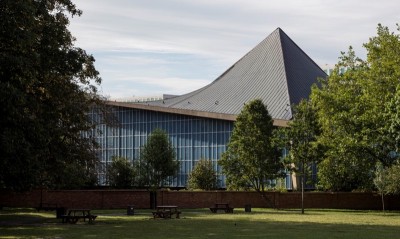
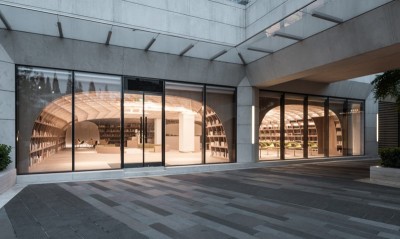
The Yitang Music Centre occupies the top floor of a relocated resettlement building inside Hangzhou Damei Creative Park, beside the China Academy of Art's Xiangshan campus and backed by the Longwu tea hills, and is a renovation by Lixiaoxi Architectural Design Studio led by Li Wenxi, with Zhou Wuji, Wu Yan, Chen Cile and Zhu Yinqiu on the team and Lai Pengfei as structural engineer. Commissioned at the end of April for a mid-July opening, the project had one month for design and six weeks for construction. The existing building carries a four-slope umbrella-like roof supported by six concrete columns, a common contemporary Chinese concrete form that clumsily echoes traditional wudian and lu-ding roofs yet inadvertently engages architecture's fundamental act of "covering". The architects took the umbrella as the premise and asked how a settlement of rooms could gather beneath it. After stripping non-load-bearing walls, they inserted a warm, dense birch timber framework - 150-millimetre square posts and beams fixed to the concrete columns at 2,400 millimetres - as a human-scaled counterpoint to the heavy concrete. From this, clusters of timber rooms grow on two levels: on the ground floor, birch boxes of varying sizes press against or face one another across corridors; on the first floor, aluminium-clad music rooms slip between the umbrella beams, their cool skins reflecting the concrete roof and physically lowering the loft-level summer heat. An elevated corridor cuts across at 2.4 metres, but rather than splitting the void it is floored in translucent metal grille so that people above are felt below and light from above reaches the ground floor, linking warm timber and cool aluminium. Round windows at the corridor ends frame the tea hills, and the entrance stair reuses the original removed reinforced flooring as a patterned wall skin. The project is a study in how, in the existing-building era, an architectural vocabulary of old and new, inside and outside, level and temperature, touch and coolness can be orchestrated into an interior world of distinct atmosphere.




 Editor's Pick