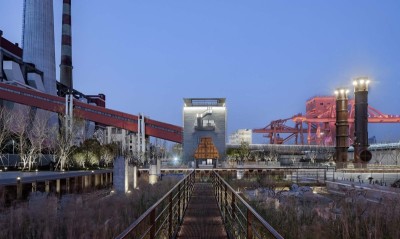
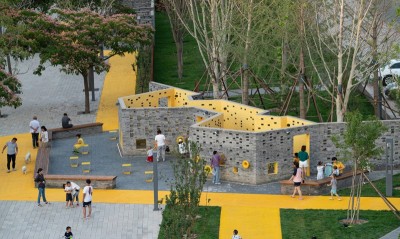
Text description provided by the architects
NCD Studio:This design was inspired by an ideological transformation two decades ago. As the venue for the golf competition of Asian Games Hangzhou 2022, proprietors hoped to renew and renovate in accordance with modern aesthetics and environmental value based on the original design of Jack Nicklaus 20 years ago. Meanwhile, they also wanted to construct a golf course of original ecology. Traditional gardens are mostly affiliated to buildings. The landscape of the golf course is unique. They are different from average public or real estate projects, as construction or planning is taken as the central framework. The framework of the project landscape basically formed. The gold landscape can be viewed as a massive garden, including the tee ground, the ball groove and the putting green---they are essentially part of the landscape. The professional power of discourse and level of freedom improved significantly. But some challenges occurred in terms of border and element design, which should be handled in different ways and approaches. Over a time span of two decades, the ways of handling the challenges kept changing, which were actually determined by the changes in value orientation, aesthetical standards and environmental thinking. The venue is an open site surrounded by hills with the American design characteristics of the 1990s: the American countryside architecture, the space with distinctively multiple layers and plant arrangements with traces of real estate.... When arriving at the venue for the first time, we discussed and sought clues about creating a comfortable context of conversation between man and nature. In the beginning, we merely hoped to make the conversation more abstract and close to instinct, so as to incorporate it into the surrounding space. During the on-the-spot survey, we found the separation belts consisting of lodgepole pine, metasequoia and camphor trees. They divided the natural golf course into yin and yang sections. After many years of development, the unique beauty of rhythm and texture was what we hoped to retain, i. e. the sense of spiritual originality. The initial designs could hardly be found in the junction areas between the ball grooves, water edges and construction borders. We also planned to focus on the junction areas. The surprise of design is: the unique texture should be included in the non-native language context. Otherwise, it is another type of duplication and standardization of dimension, i. e. the strange sense of intimacy. The whole project is primarily oriented by landscape and even plants, which can be deemed as another type of simplicity. The distant mountains and the native plant on the spot demonstrate their unique texture and wild beauty. What we need to do is to scatter, recombine, rearrange and reassemble the irregular sense of wild beauty, in order to eliminate artificial traces. The design analyzed the multiple aspects of original plants in the gold course, such as appearance and habit. Nearly one thousand trees were displaced. Based on intrinsic “seasonings”, certain types of small arbors and ground cover plants, including maiden grass, Chinese pennisetum, grama grass and juncus effuses, were added and rearranged. With the original artificial lake and flood discharge runoff, we added metasequoia plantations to the dispatching center of the golf course. Then, a small backyard garden was created to reduce the pressure of flood discharge and attract animals to stay. With the help of previous experience two decades ago, we left more room for growth on the water edge. The purpose is to let people, animals and plants engage in and witness the self-renewal and self-repair process over the long term in the future. Take advantages of hills. The most interesting point of the renewal projects is the site design: other than the entrance and positions relating to construction, there is almost no design sketch or even explicit scheme. Instead, many “parks” were put in place for substitution. Today people may feel sorry for a damaged bamboo forest. Tomorrow they might find a precious tree in a corner of an unimpressive lake. The design also arranged the original plants: by taking advantages of the texture of similar tree belts and eliminating impurities, the whole site had more sense of integrity and vitality. Take advantages of water. Another major focus is the design of artificial lake and wetland, which is also the area closest to the animals and plants in the site. We added supplements to the submerged and emerged vegetation in the wetland areas. They are not only the important primary producers of the aquatic ecosystem but also the regulators in the key interface of the ecosystem, in order to protect the wildlife habitat for birds and fish. Take advantages of wind. We covered the ground surface mostly with buffalo grass and grama grass. These grasses have soft and thin texture and often sway freely in the wind. Occasionally, the seeds of Juncus effusus float among the buffalo grass, creating an amazing picture. Additionally, in a lot of underwood areas, we chose to retain vacant regions by covering them with the pine sawdust, in order to make it easier for subsequent maintenance and reducing manual intervention. This project encourages people to think more about the connection between man and nature. Currently, due to various factors like land waste and the destruction of natural resources, policies tend to spur new construction and renovation of golf courses. Hence, by seizing the chance of renewing the venues in this Asian Games, professional and joint efforts are gathered to turn the site into a living entity with sustainable self-growth, so it can seamlessly connect with nature besides functionality. In the next several years, no more human intervention or change will be required. In this regard, the connection between natural ecology and human activities becomes a cyclical movement, which keeps repeating and forges mutual equilibrium and balance along the progression of different life cycles. It represents the long-term adaptation to changes in external environmental conditions. Since it stems from nature, it will return to nature in the end.




 Editor's Pick