Text description provided by the architects
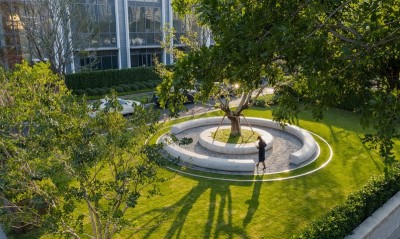
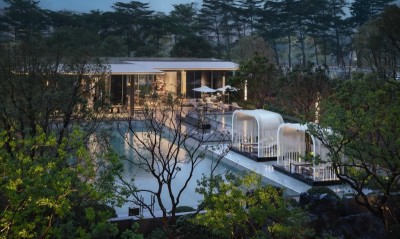
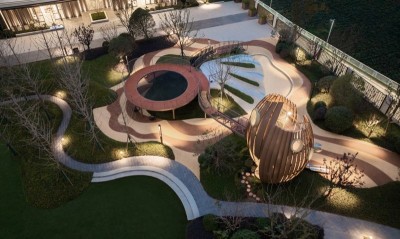
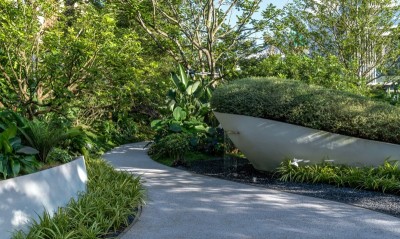
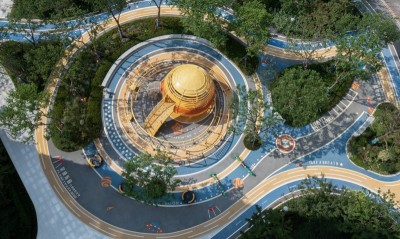
The Tianhu Cuilin marketing centre for Hongkong Land sits in Chengdu's Qingyang New District, on a narrow strip of land immediately east of the Qingshui River and adjacent to Pidu District to the north, positioning itself as a second home ten kilometres from the city centre. Drawing on Chengdu's three-thousand-year history of hydraulic civilization, from Li Bing's Dujiangyan irrigation system to the Linpan village settlements of the western Sichuan plains, the design team treats water not as a decorative motif but as the underlying structure of local identity. The original site was long, narrow, and visually unremarkable, so the strategy was to add landscape layers, plant scenes, and a simulated river valley that would both stage the sales experience and repair the weak street-facing edge. The first zone, Mirror Lake and Green Forest, uses a sinuous riverbed to thread the entire block, with dense Linpan-style planting creating natural open under-canopy rooms; stainless-steel signage catches light like a still lake, and an art garden is combined with the commercial frontage so that beauty and everyday use coexist. The welcome forecourt pairs weathered steel with washed concrete, two tall low-branched hackberries framing the building, red maples as accents, and massed perennials in soft tones, while an irregular stainless-steel sculpture sends mirror reflections across the paving. A cascading waterfall and mist system in the transition between car park and sales office add a quiet, cooling atmosphere, with Japanese maples shifting colour through the seasons. The canyon gallery lifts visitors through a constructed ravine whose multi-curved walls were the project's greatest technical challenge: after nine material trials, washed concrete was selected to reproduce the weathered bedrock texture, and on-site craftsmen sculpted the forms by hand. The result is a 2,900-square-metre landscape that links the 55,066-square-metre site to the river, distills Sichuan's hydrological and Linpan traditions, and offers urban residents a brief, immersive detour into a simulated river valley.




 Editor's Pick
 Latest Design