Text description provided by the architects
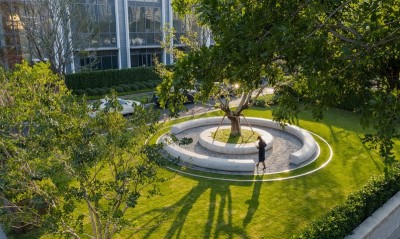
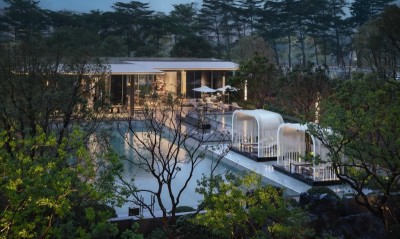
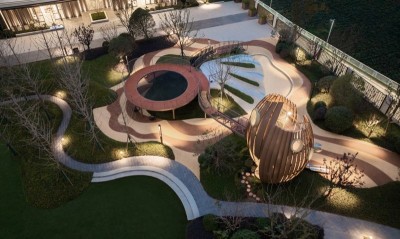
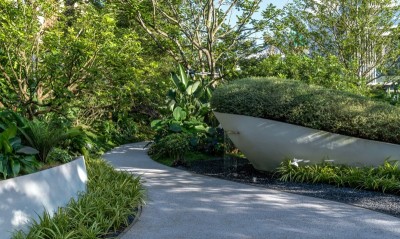
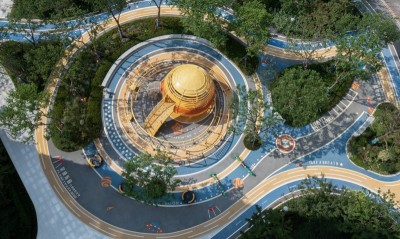
Ganzhou's Binjiang Courtyard is a residential landscape that reads the layered history of its host city through the structure of a traditional Chinese opera. Set in Nankang, Ganzhou, Jiangxi, a city defined by its thousand-year-old city walls, the Zhang River, floating bridges, and timber-framed heritage, the design treats the courtyard not as a grand monument but as a single act within a larger theatrical cycle. The entry sequence unfolds in four movements, echoing the classical principles of raising, carrying, turning, and closing. At the raising stage, visitors approach through a grand porte-cochere of patinated bronze grilles paired with matte mocha marble, flanked by gently mounded planting and sculptural pines that frame arrival without overwhelming it. A silk-laminated glass wall printed with a landscape in the manner of the Song-dynasty masterpiece A Thousand Li of Rivers and Mountains sets an immersive tone. Through the gate lies a water court in which placed stones, greenery, and pavilions reflect on still water, staged as a modern mountain-and-water scene. To the left, a winding broken-slab path leads to the central hall through lush planting; to the right, a contemporary Song-style covered bridge frames symmetric lighting and welcomes guests alongside the opposite gate. Deeper within, a waterside promenade passes red maples, drooping holly, rounded boxwood, golden sedum, ferns, and horsetail, the stones low and natural in a layered composition. The turning movement reveals a forest court reached by a floating bridge: pavilions rise among mist-shrouded rocks and sculpted maples, translucent glass blocks glow behind ferns and miscanthus, and a screen partition frames shifting views. The closing movement returns to calm at the VIP drop-off, where low micro-topography grass slopes and a quiet porch restore the restrained Song-era etiquette of receiving guests. Through trellises and grilles, the inner garden is half-concealed; a floral path leads to the future residence beyond. Across a site of roughly 7,198 square metres, with 6,413 square metres of landscape, the project distills Song-dynasty literati aesthetics into a contemporary residential welcome sequence, using opera as a narrative device to bind water, stone, planting, and architecture into a single, carefully modulated promenade.




 Editor's Pick
 Latest Design