Text description provided by the architects
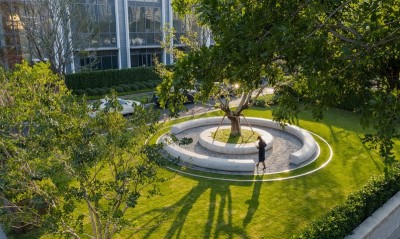
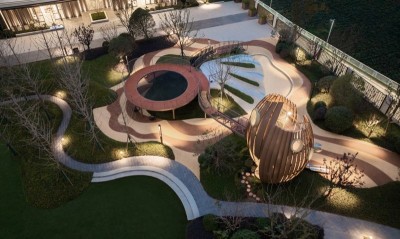
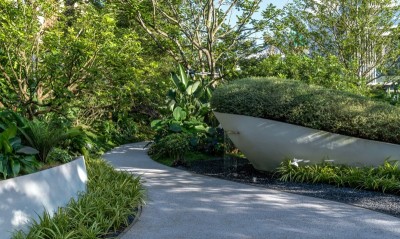
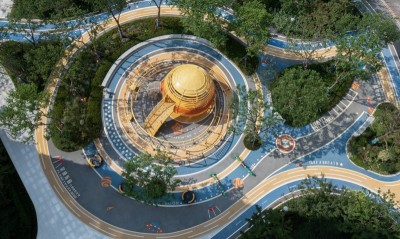
Ligao Junyu Cheng is a large residential landscape in Nanchang, Jiangxi, designed by WeiMa Design (Chengdu) for developers Ligao Group, Yihai Group and Nanchang County City Investment. The 174,500-square-metre site comprises commercial and residential components, with 142,650 square metres of landscape, and is organised around a scientific, nature-led planting strategy. The team begins from the British landscape architect Brenda Clouston's dictum that ecological planting should be conservative, ornamental, diverse and economical, and pushes back against the Instagram-driven, look-alike landscape culture of the moment in favour of pure, natural, living planting. Because the site is so large, the design focuses on user needs and functional nodes, using planting to elasticise space, raise landscape premium and build ceremonial arrival sequences. The planting strategy is staged by zone. The axial arrival court is treated as a formal, symmetrical tree-lined boulevard with a high proportion of large stature trees - clustered hackberry, zelkova, silver osmanthus, Nuttall oak and willow-leaf osmanthus, five to eight metres tall and planted in arrays to create a dense, ordered grove; small ornamental trees are reduced and ball shrubs such as boxwood and viburnum used as colour bands, producing a layered transition from the main tree canopy to the ground plane. The lawn and landscape-living-room zones increase the grass-to-shrub ratio, with osmanthus, hackberry and camphor continuing the axial tree cover as background and waxberry, early cherry and crape myrtle interleaved at mid-height for seasonal colour. At road junctions and landscape nodes, complete ecological communities are assembled - camphor, ginkgo and elm combined with ball shrubs in single or nested rings, reducing both capital cost and long-term maintenance. At unit entrances and gable corners, the mid-storey is deliberately removed and large ball shrubs substituted for small trees to intensify arrival quality. Planting accounts for 61 percent of the landscape budget, with an even 5:5 tree-to-shrub ratio; the project is conceived as permanent, low-maintenance, self-circulating and naturalistic, and opened in 2022.




 Editor's Pick