Text description provided by the architects
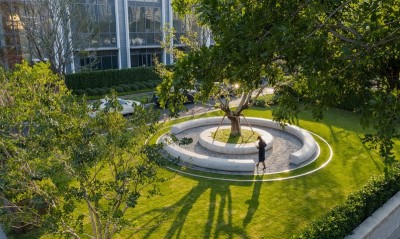
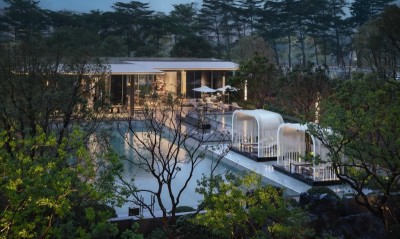
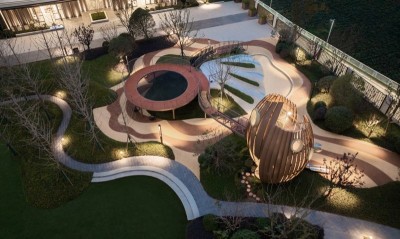
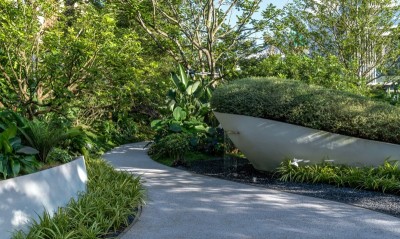
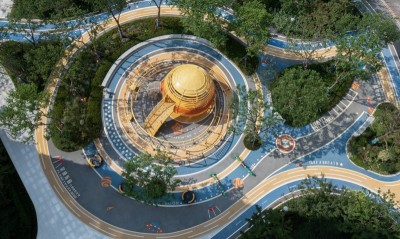
Designed by WTD for Chengdu Longfor, Jiuli Qingchuan is a residential landscape that deliberately steps away from style, programme and slogan debates to ask a quieter question: what kind of public space can actually hold everyday life? On a dense urban site the team is given two roughly 75-by-100-metre courtyards, a generous inheritance in contemporary Chengdu, and they use that scale to stretch time rather than to pack features. The landscape is composed as a flower slowly opening, so that residents move through layered, petal-like rooms and arrive back in the present. A winding ribbon of water leads the eye into distance, reading now as moon, now as cloud, now as spring wind over a courtyard, its stillness and softness meant to slow the pace of anyone returning home. The water is studied in scale, movement and material at every encounter so that its effect is always long and slow rather than theatrical. Within the larger courtyard, a crescent-shaped pond wraps a peninsula that encloses a "Hundred-Plant Garden" quoting Lu Xun's childhood Baicao: tall gleditsia, straight metasequoia, pennisetum and miscanthus are planted so that morning dew on grass tips becomes a small everyday wonder, and the winter die-back is left visible so that children learn the cycle of death and renewal firsthand. A cloistered, resort-style corridor overlooks this garden, its proportions and light-shadow transitions tuned so that a slow walk can fill a spring afternoon or a summer dusk. The west-to-east route passes through a fragrant garden of camphor, osmanthus, wintersweet and michelia, then into a fruiting pomelo grove that becomes the elders' meeting ground, shaded in summer, sunlit in winter, scented by fruit in autumn. A children's garden is divided by age: zero-to-three sand and slide zones with adult care stations, three-to-six multi-play structures for emerging social play, and six-to-nine terrain-based mounds with an egg-shaped perforated volume that lets older children invent their own games. Villas and towers are screened by tree masses, and the waterside walk gives high-rise residents a soft, lingering path home. The project argues that residential quality is not a style but the creation of humane space, and that the designer's job is to relax the ground plane, stretch time, and let life return to life.




 Editor's Pick