Text description provided by the architects
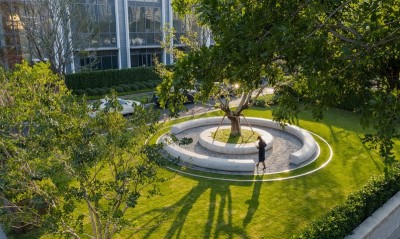
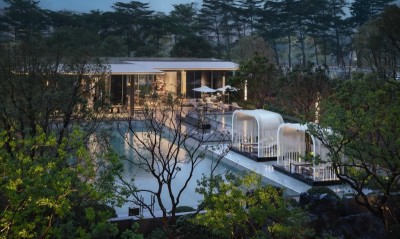
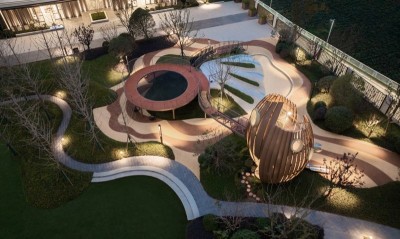
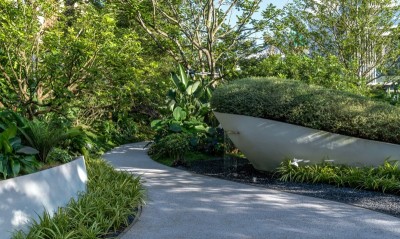
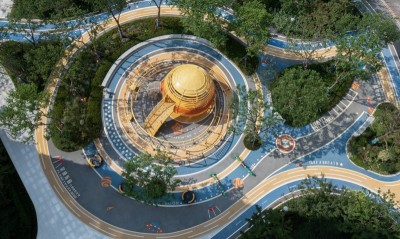
Qushui Huiying, the high-end "Fu" series residential landscape by Sunac Chuan-Yu on the Chongqing Cultural Tourism City site, is a sustained translation of Tang-dynasty urban and garden culture into a contemporary neighbourhood, led by WTD Design after years of internal research into Tang city planning, architectural form, garden art and daily life. The flat, formally laid-out site generates three band-like landscape axes: a 253-metre east-west spine from the main western entrance to the far eastern edge, and two north-south spines of 279 and 267 metres, interlocking into a chessboard fabric that recalls the Tang fangshi ward system of one axis, two markets, three palaces, five canals and 110 wards. Borrowing the Tang garden principle of "three advances, two courts, five returns home," the long east-west spine is subtly subdivided into a sequence of courtyards, each treated as a modern restatement of a Tang mansion gate: low, symmetrical, horizontally broad eaves that, through upturned corners or lightweight grilles, focus the view into small framed scenes. The first court imagines "clearing wind through tallow trees over a water court," with mist over a mirrored terrace playing on the Chinese cosmological motif of square earth under round heaven; beyond a screen wall, the "Star-Moon Still Terrace" renders lunar phases as a circular stone disc, its black-and-white field reading as a pale moon, scattered with ground lights. A tall, straight bamboo grove forms a ring-shaped open communal space, evoking Wang Wei's bamboo pavilion where scholars played the qin and drank tea, while a later court with tiny waterside pavilions and textured stone walls invites the same slow ritual. The children's area is narrated through the Lantern Festival, translating Tang customs of street theatre, spring gardens, moon viewing, riddle-guessing and lanterns into interactive play that serves all ages. The project is presented as an iteration of high-end residential product rather than a stylistic period piece: Tang ritual order, garden craft and everyday pleasure are distilled and re-composed against modern functional requirements.




 Editor's Pick
 Latest Design