Text description provided by the architects
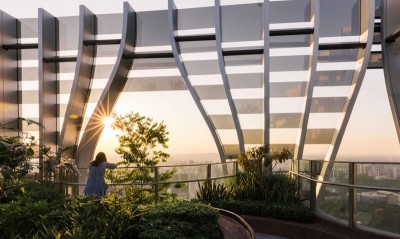
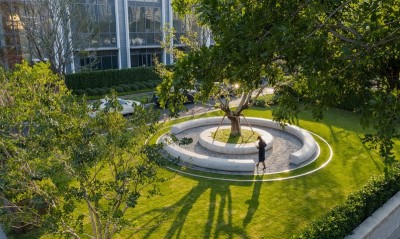
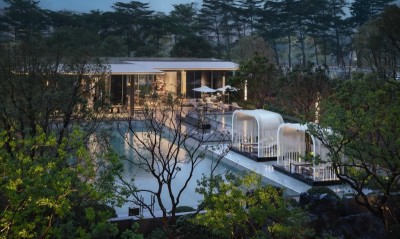
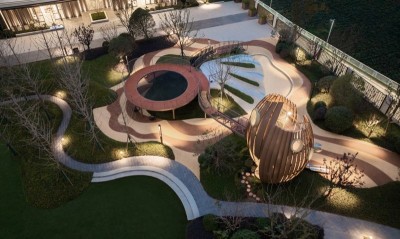
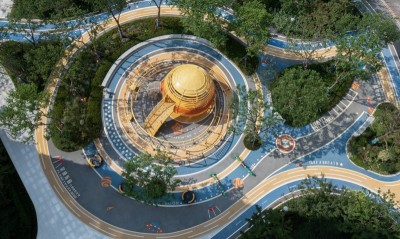
Poly Yuedu Yuntai, at the corner of Huining Street and Huifeng Road in Qiaoxi District, Shijiazhuang, is a new community inserted into an old neighborhood. City change inevitably leaves seams between old and new; older planning often produces missing spaces, while a well-planned new community can repair those defects, bring new lifestyles and activate stale ground. The site itself was a forgotten corner: simple red-brick buildings, demolition rubble, dead-end roads, broken walls and an unplanned riverside strip, a space that felt abandoned by the surrounding blocks. The designers and client decided to treat the early display portion as a demonstration community reception that would activate the whole street. To bring new blood to the old fabric, they inserted a geometric vocabulary of circles and arcs, with clear symbols on the ground and in the air that unify the street atmosphere. The most important resource for activating the site is people, so a composite public space is placed at the center, linking the future community entrance, the commercial frontage, the existing municipal road and the old blocks; it acts both as a container for urban life imagined for the new community and as an attractive setting for children's play and neighborly exchange that the old blocks lack. Several white, connected circular structures give the outdoor room a roof, producing a psychological sense of safety; spring water, human-scaled planting and continuous round or arc benches then fill the space, so that elderly neighbors can sit for a whole afternoon. A circular children's play system and bright arc-shaped installations give the place its character, and a sand pit adds a new kind of play to the neighborhood; the small corner becomes the final destination for after-dinner walks with children. To the south, the site will meet the new community's commercial frontage, with water features and a lobby on the future homecoming route, so that the corner can flexibly host commercial and community events. The design went through repeated iterations to fit the surrounding context and public needs, and digital-assisted design plus factory tracking closed the loop on the irregular structures; under Shijiazhuang's strict environmental rules, prefabrication reduced on-site work and air pollution while protecting schedule and quality.




 Editor's Pick
 Latest Design