Text description provided by the architects
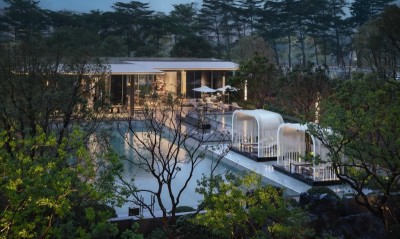
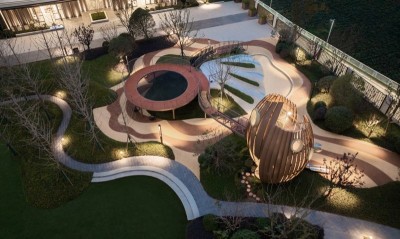
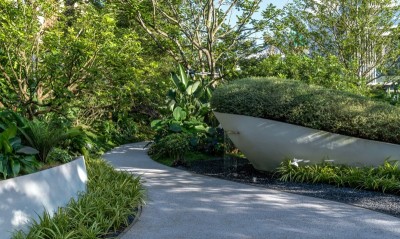
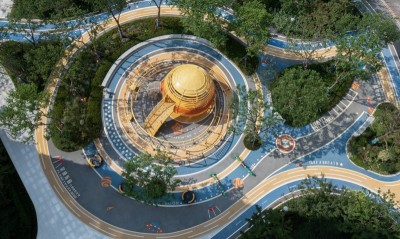
Wanhua Jiangdong Lu Island Yan Art Museum in Haikou is a public art space that aims to create a perceivable field beyond formal representation. The building integrates deeply with the landscape as an earth-sheltered structure, restoring a lake, wetland and forest that evoke Hainan's ecological character while conveying the aesthetic of a sculpture park. The first impression is a soft white ribbon flowing across the site, its curving lines continuing the building's artistic language and linking spatial transitions. White walls form a canyon passage that exits into dense forest. A deer sculpture appears in deep mist, adding a layer of fairy-tale rainforest. As the path opens, cloud reflections on still water reveal the building as a floating green island. Cascading water features are carefully layered, with planted pools like floating boats in front of the building, partially screening views. The earth-sheltered museum uses a massive circular form that creates an island, with plants growing around the building under the perpetual sunlight at latitude 20 north. The central courtyard, veiled in mist, uses large broad-leaf and moss plants to create a miniature rainforest. The design breaks the boundary between architecture groups and landscape social space, connecting lake, wetland, meadow and forest in parallel, intersecting and fusing layers to promote biodiversity. Forest and wetland have no boundaries, and neither do people and nature; emotions flow with space, and the entire place is immersed in green. The project aims to let visitors pause, converse with space and with themselves, read the language of time, and make art part of daily life.




 Editor's Pick
 Latest Design
 Best Idea