Text description provided by the architects
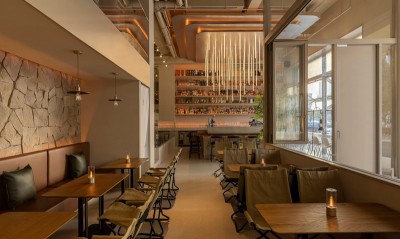
Yihui Xi, a Japanese-style kaiseki restaurant, occupies a restored courtyard house in the Luxihui historic quarter of Jiaxing, an ancient water-town city at the confluence of rivers and the Grand Canal. Jiaxing has been a land of fish and rice since early history, with dense waterways and a rich agricultural economy, and Luxihui itself was once the city's earliest commercial center, named for the rush matting that was sold and stacked along its wharves. Five waterways meet here, and the neighborhood was rebuilt along traditional Jiangnan dwelling lines, with front courtyards facing the street and rear doors opening to the river, many fitted with waterside pavilions and private stone steps, so that both land and water routes connect. Boats drift past at dusk as lanterns flicker, and warm light spills from white walls and dark tile eaves, the classic image of misty Jiangnan. The restaurant's visual core is its inner courtyard, around which all circulation and dining rooms are organized; planted in it is a three-hundred-year-old Spanish olive tree, its trunk gnarled and branches vigorous, reaching into the sky within a confined footprint, a charged symbol of vital growth. Seating beneath the ancient, weathered tree calms the mind, and natural beauty is allowed to move people. Clear glass surrounds the olive so that diners sit within an immersive forest-like landscape while maximizing daylight. At the entry, a floating washi-washitsu private room for four acts as a visual partition, creating mystery and preventing an immediate overview of the whole space; beneath the suspended tatami platform, a dry landscape of varying-size stones and rough natural boulders is set out, and the washi screens can be opened or closed freely. The design treats the historic waterside setting and the slow, ritual experience of kaiseki dining as one continuous spatial narrative.




 Editor's Pick
 Latest Design