Text description provided by the architects
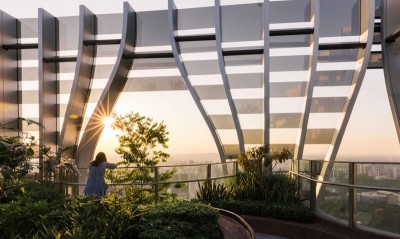
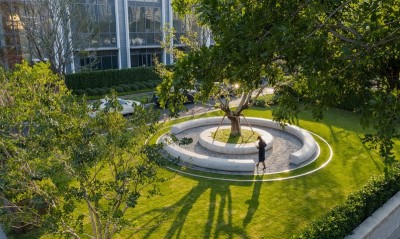
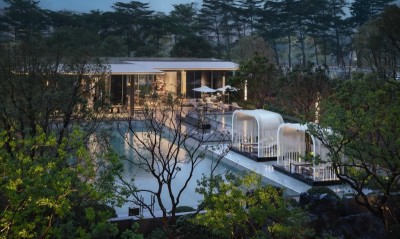
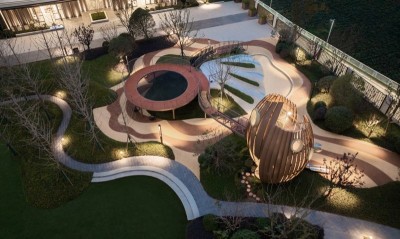
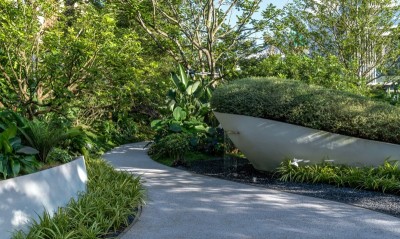
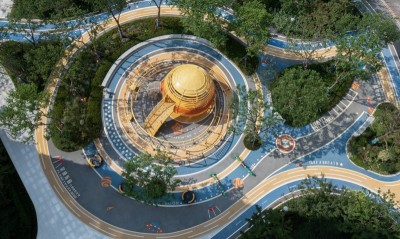
Longfor Yuhu No.1 in Chongqing's Lijia sub-district sits on the Jialing River, a place Du Fu celebrated in the eighth century as "Jialing's water, like jade and dark-green, returns from the sandbars each spring". New Lijia, in the core of Chongqing's Liangjiang New Area, combines low plot ratio with rich natural landscape, and Longfor has paired a super-regional commercial district with a luxury lakefront residential enclave. The 330-mu site, with a 2.6 plot ratio, is positioned as Chongqing's first true waterfront business district. The landscape by HWA (Shanghai) takes the traveller on the Jialing - the client, Longfor, the Liangjiang New Area - as its narrative thread, weaving a thousand years of river-shipping culture into a three-act journey: first sight, return to port, and entering a dream. At the entry, lines from Qing-dynasty poem "Crossing the Jialing" - red rushes at the river mouth, a small boat crossing the dawn wind - are translated into landscape elements. A rising stair turns repeatedly, using the classical technique of suppressing before revealing: glass walls hint at the inner courtyard without revealing it, and sculptures evolve from paper planes to paper boats, symbolising Chongqing people who have soared through the world and now return to shore. In Chongqing's famous mist, egrets - emblems of purity and safe passage - become recurring motifs. At the shore, natural textures of sandbars and receding waves are abstracted into a revetment; a cantilevered deck juts out like a ferry landing or a ship's stern, framing the most complete view back to the "speed boat" sales gallery. At night, underwater star lights turn the water into a field of light. To the left of the egret, a sliding door opens onto a 600-to-700-square-metre lawn for medium gatherings, deliberately offering visitors multiple routes rather than a prescribed path. Inside, real flower fields and bronze water-sculptures that bloom like flowers lead along a pergola to the broadest cantilevered terrace, dissolving indoor-outdoor boundaries. Walls double as landscape, their layered forms echoing mudflats and a fleet of ships ready to sail, while bubbling springs carry Eastern zen and sail-shaped sculptures mark departure. The 14,230-square-metre project is framed as a new high-water mark for Chongqing luxury living.




 Editor's Pick
 Latest Design