Text description provided by the architects
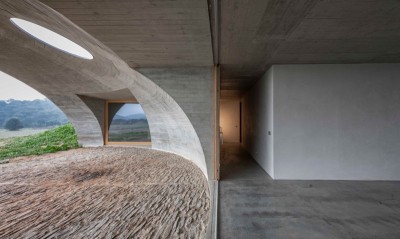
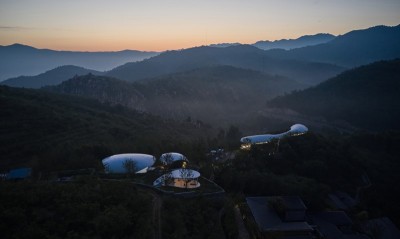
The hilltop leisure and aesthetic pavilion for Longfor's Fuxian Lake Star Town sits on the shore of Fuxian Lake in Chengjiang, Yunnan, one of China's most beautiful freshwater lakes, its blue waters stretching to the horizon under an immense sky. The site's mood is spare, wild, and elevated, and the design team responded with equal restraint, using a natural vocabulary of texture and material to evoke a return-to-nature sensibility. The hilltop resort experience zone is composed of four small independent buildings, reached by shuttle bus from the lower sales centre along a lakeside path that leads visitors through the mountain-water panorama. Fuxian Lake's vastness inspires a sense of awe: standing between lake and mountains formed over geological time, the architects sought an architecture that would not compete. Drawing on Laozi's idea that heaven and earth endure because they do not live for themselves, the design treats lake, mountain, vegetation, and building as a single whole, allowing everything to grow from and return to nature. Each of the four buildings is positioned so that lake, mountain, cloud, and sky enter its rooms, without asserting itself. The landscape area, just over 2,000 square metres, extracts its elements, proportions, materials, and colours from the site itself. The entry sequence is formed by a series of low walls that wind through courtyards, their edges following natural flow to guide movement and settle visitors into the present. Most walls are finished white, so that they dissolve into the expansive landscape while conveying purity and calm. Wildness is deliberately preserved: trees lean through wall openings, native grasses and wildflowers sway in the courtyards, and the planting stays loose and unmanicured to support a slow, unhurried atmosphere. At the foot of the buildings, a still water feature is aligned so that the open lake appears to extend right to the terrace, letting visitors sit and watch light and time move across the water. Designed in 2019 and completed in 2020, with a landscape area of 2,156 square metres, the project uses simplicity, humility, and ecological restraint as its core materials, framing a quiet dialogue between self, architecture, and the immense lake.




 Editor's Pick