Text description provided by the architects
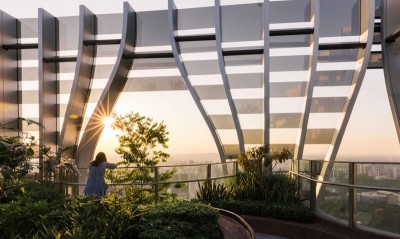
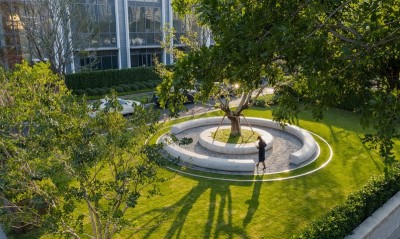
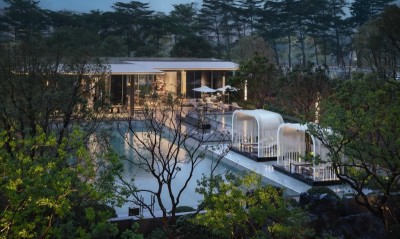
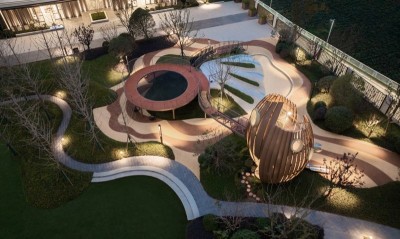
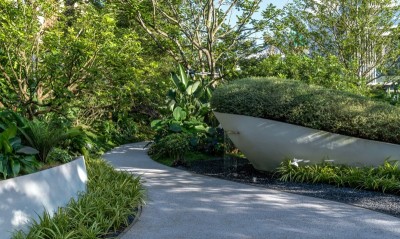
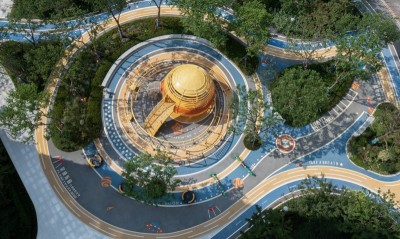
Poly Tianhui sits in the centre of Hangzhou's Binjiang high-tech district, eight kilometres from the historic city centre and nine kilometres from West Lake, surrounded by the R&D campuses of global companies including Alibaba, NetEase and Huawei. GVL Yijing International Design Group was asked to distil the refined, leisurely spirit of Hangzhou's landscape culture into a residential landscape for modern households, a 31,572-square-metre scheme completed in September 2022 after design began in December 2020. The starting point is the city's long association with West Lake, osmanthus, lotus, tea and poetry, and the design translates these into seven sequential atmospheres rather than literal scenes. At the entrance, metal and stone combine with a waterside forecourt to form a hotel-style drop-off, symmetrically composed but softened by planting, with shallow steps and running water that quieten the approach. The art-wall and water sequence continues into a grey-and-black procession that sets a calm, refined register; dappled light moves over stone, timber and flower borders in an allusion to the famous line about sparse shadows crossing shallow water. Irregular triangular paving motifs organise the central water garden, where narrow ribbons of water, floating bridges and planted islets replace a single large lake, so that reflections, lighting and negative space play against each other. The living-room pavilion continues the gatehouse language, opening a sunken bar and seating area where residents can sit through the seasons. A sloped lawn forms the children's world, split into an upper woodland play deck and a lower open grass field, with an art installation by China Academy of Art professor Shi Hai, a woven-steel form whose brim flutters against its rigid frame. The stroll continues through shaded avenues lined with plants and paving drawn into simple geometric bands, and finally into the elevated lobby, where louvres filter light like a moment by West Lake. The whole project is framed as an experiment in Hangzhou-style living: a quiet, beautiful, slow-paced community that lets urban residents pause, notice the weather, and recover the ease that the city has long been known for.




 Editor's Pick
 Latest Design