Text description provided by the architects
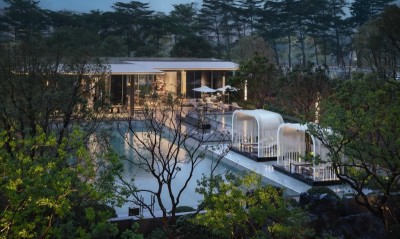
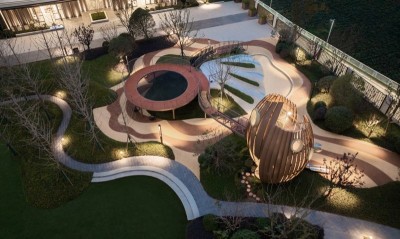
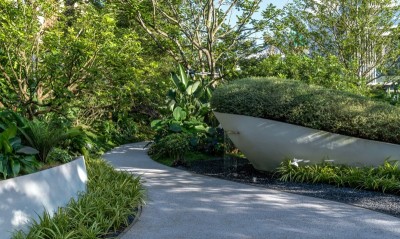
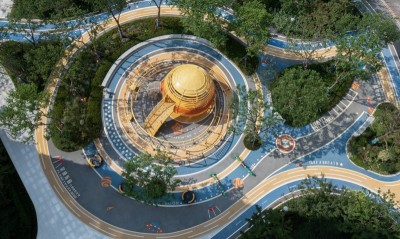
Sunac Yinxi Xiaoyuan in Chongqing is a residential demonstration and public landscape of 5,000 square meters in Yubei Central Park, developed by Sunac Chongqing and designed by A&N Shangyuan Landscape, with contractor Senlan Landscape Engineering. Taking its cue from a Ming-dynasty quatrain on the quiet life of watching flowers fall and clouds roll, the project treats landscape as fusion rather than transmission, and unfolds along a processional axis through four scenes that narrate a reclusive urban life: Suspended Stone, Forest Stream, Reflected Water and Returning Garden. The Suspended Stone entry is defined by two high grey walls rising into the sky, pierced by one-to-one square openings through which a glimpse of the beyond provokes curiosity while hinting at the next spatial dimension. Rest benches flank the plaza, and semicircular arches stretch between ground and ceiling, partitioned into a series of independent booths arranged in order; seated on soft cushions, visitors feel sunlight filter through branches, hear water flowing and enter a Peach Blossom Spring detached from worldly noise. The Forest Stream passage enters a shadow-play courtyard of staggered walls and cypress trunks reaching toward the light, where tree shadows and zen silence leave nothing to say. The Reflected Water scene turns through an arch that breaks the dream and frames a view of bright sky, rows of trees and sunlight printed onto white walls; two ranks of erect peacock pines establish sequence and depth, strengthening the procession and producing a luminous water corridor that dissolves the closedness of a traditional pergola. Water flows on both sides, mist wraps the visitor like a recluse stepping into a fairyland, and as evening softens the light, interior and exterior tones modulate from bright to dark and back, with lamps drawing simple lines where trees and light compose a picture. The Returning Garden at the rear uses sunken booths set among peacock pines, whose minimalist pure lines give the interior a sense of disappearance; with moon, shadow and warm wine, the heart clears and the world opens. The designers extend the reclusive philosophy at two scales. At the street corner, four pairs of named stones, Island Mountain, Bohai, Penglai and Fanghu, allude to the four legendary immortal mountains, using small gestures to suggest that the precinct is a quiet elegant place within the bustling city. Throughout, one-to-one square geometries are reused to express the most primitive, stable state of mind and a simple, pure attitude toward life. Yinxi Xiaoyuan is both scenery and a homecoming, requiring a quiet, reclusive heart to cultivate oneself and savor the pleasures of forest, spring, mountain wind and the clear hermitage it creates.




 Editor's Pick