Text description provided by the architects
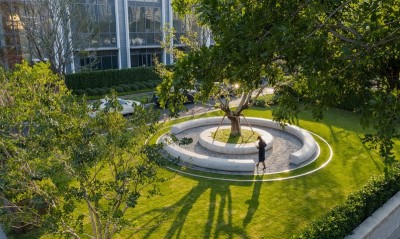
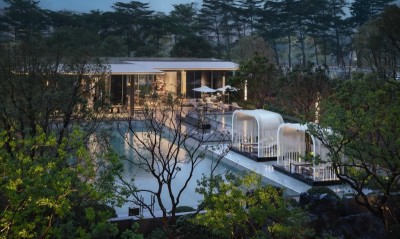
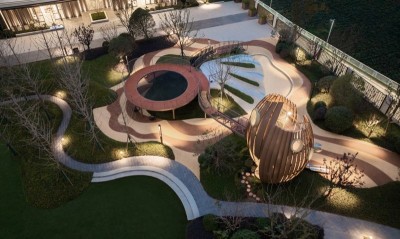
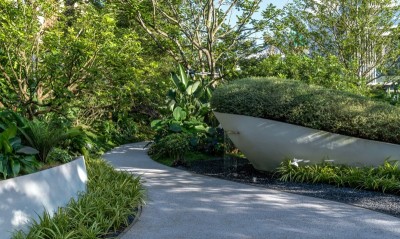
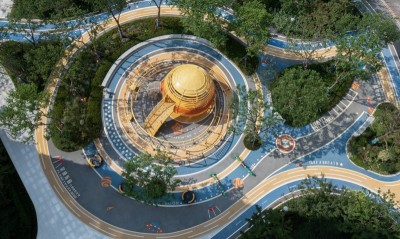
Longfor Chunshan in Chongqing, situated in the Cailiang cluster north of the main city on one of the most active growth corridors of the municipality, occupies a wild site where egrets roost, rivers, hills and woodlands meet, and the original ecology remains largely intact. The design team, led by WTD Landscape and contractor Luohan Landscape, settled on Eastern aesthetics as the guiding tone: traditional courtyard space as form, Song-dynasty aesthetic spirit as breath, and contemporary materials and craftsmanship as language, producing a refined, restrained, poetic residence. Song culture is cited as the world's earliest minimalism, where ink in five tones outranks polychrome; the project embeds symbols of mountain-water, calligraphy and literati painting and binds the site through four elements: mirror, tree, water and stone. The gatehouse borrows the form of a Song mansion while stripping away literal ornament, using dark eco-timber on either side and calligraphic latticework drawn from the slender Gold-plaque script, set against a 12-meter-long reflecting pool with a seamless black-stainless-steel waterfall that lengthens perspective. The Mirror Courtyard's main screen wall is inspired by Emperor Huizong's Auspicious Cranes, hand-engraved by artisans into stainless steel behind a slowly flowing curtain of water so that the cranes appear to fly through liquid light. The Tree Courtyard is the throat of spatial transition: a tall guiding wall of eco-timber and brushed steel conceals what lies beyond, while steep steps flanked by dense purple-leaf myrobalan and zelkova create dappled shade. The central Water Courtyard opens like a silent landscape painting, its mirror pool holding a floating green island and ink-wash petals rendered in stone mosaic laid by digital templating; a sculpture of the winged fruit of the camphor tree echoes the project name Chunshan, complemented by carefully selected jacaranda. The final Stone Courtyard, carved with glowing resin stones in a dry-garden idiom, pairs rock, bamboo, floor-to-ceiling glass and light to reinterpret Chan meditation in contemporary materials.




 Editor's Pick