Text description provided by the architects
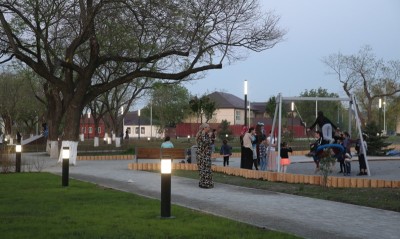
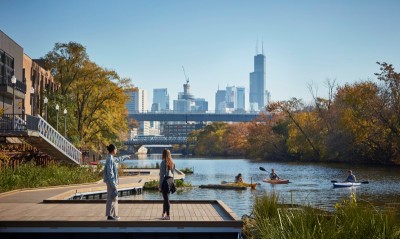
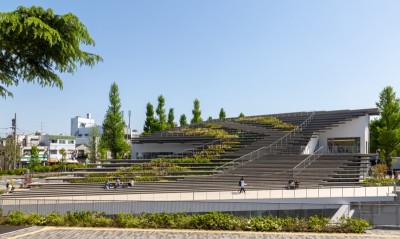
The Chengdu Plain, enclosed by mountains and central Sichuan hills, has historically been the flat Land of Abundance; but as Chengdu grows, the mountain has shifted from distant prospect to immediate experience. Tianfu Vanke City sits at the southern end of the Tianfu Avenue axis where it meets Longquan Mountain, an area of rolling hills, lakes and streams degraded by years of farming and neglect. Sasaki, led by director Zhang Tao, is responsible for the overall landscape and framework of the 173-hectare project, treating the site by principles of based-on-nature, reinterpreting-nature and fusing-with-mountain-water, to restore ecologically functional landscape and a livable, visitable hillside community. Four visions guide the work: a natural landform park exploring Chengdu's new mountain and rural character; restored water ecology through improved channels; protection and recovery of native species and biodiversity; and playful interaction between people and nature. GIS analysis of the complex terrain guides roads, slow-mobility systems, waterways, landscape zones and outdoor activity. Ridgelines and two catchments divide the project into interconnected south and north valleys, whose streams and wetlands descend to two landscape lakes at the valley mouths, with ecological buffers sized to runoff estimates. The gently sloping south valley, most accessible, is developed first with family and children's programs; the richer north valley hosts mountain sports; the inner mountain near Longquan offers deep nature immersion. A trail system connects entry-level to expert mountain biking, forest walks, canopy walks, hiking, camping and animal parks. The steep slope facing Tianfu Avenue, once heavily cut, is remade as an environmental-education frontage: layered paths climb to a landmark at the crest that opens a ridgeline art axis into the forest, ending at a quiet tree house and meditation space. Long sightlines and short-scene rhythm are paired with building framing, borrowed scenery and scattered narrative: bamboo, tea room and perforated brick wall frame the first lake view to a distant arch bridge and the layered Longquan range. A Stone Wall of locally abundant red sandstone—long used in traditional local houses—rises in layered, modular waves among bamboo, echoing distant hills and near gable ends while attenuating highway noise. The launch phase interprets mountain, water and field into Music Hill, Joy Water and Ease Field, connected by changing waterfront walks: a children's play mound, a lake-and-wetland water garden, and a wildflower meadow. The Cloud, atop the play mound, is a steel, cable and net structure that children climb to view the world from above and which reads from the lake as a floating white cloud. The Ripple is a stacked-slate water play pool shaped like an enlarged raindrop ripple, and The Maze is a grass-wave labyrinth with animal sculptures and stepping-stone paths. Phase one opened in autumn 2019 and has become a popular destination for local residents.




 Editor's Pick
 Latest Design
 Best Idea