Text description provided by the architects
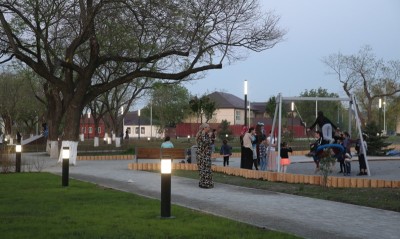
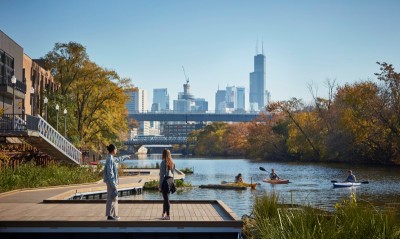
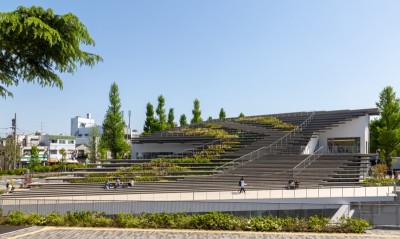
The GVL design team has created a complete landscape belt on what was originally an empty site, providing a public space where people can connect closely with the city and enjoy richer experiences. The park allows visitors to approach the water and walk along the lakeshore, and the presence of people brings new vitality to the landscape. The project is a waterfront green strip at the intersection of the Luxelakes Art Exhibition Center, the municipal road, and the lake, serving as a shared node between the eco-city and the urban fabric. It takes its name from the sculptural Art Exhibition Center building it adjoins. Originally, the site sloped unidirectionally from the municipal sidewalk down toward the water, producing a monotonous landscape condition. As an important pedestrian corridor leading from the Art Exhibition Center to other districts, foot traffic was confined entirely to the roadside walkway, severely weakening the connection between people and the lake. The team initially intended to create a single display path leading to the water, addressing the problem of being at the lakeshore yet unable to see or access the lake. After analyzing site conditions, the team re-examined the circulation pattern of the area, seeking spatial innovation that would deliver rich viewing experiences. Through terrain reshaping and the introduction of layered circulation, the originally flat waterfront slope was transformed into a three-dimensional and lively space where entering, passing, lingering, and gathering each find their proper place. On one hand, the shoreline was optimized, integrating the waterfront path with the revetment to form a more rhythmic shoreline. On the other hand, the slope was compressed and vertical variation intensified, converting the straight shoreline into valley and peak formations that possess the most natural geological character, deliberately expanding and contracting viewing sightlines to create strong visual contrast. The narrow existing revetment was extended toward the lake, with circulation layered and woven within the embankment to strengthen accessibility and broaden viewing angles. A pedestrian landscape bridge projects into the water above the waterfront valley, designed in a U-shape that encloses the main plaza and the valley beneath. The bridge connects the entrance plaza at one end and the municipal sidewalk at the other, drawing people directly from the urban road out over the water, allowing close-up enjoyment of the lake and elevated panoramic views. Serving as a hub connecting the built and natural environments, the bridge links flat ground, peaks, and valleys into one continuous spatial experience. Within this space, constructed landscapes are embedded into the rich terrain, forming the focal point of the revetment. Designed as an art sculpture in its own right, the bridge has become the park's landmark. Its form and lighting draw inspiration from red lava, entering into dialogue with the Art Exhibition Center in the distance. The valley concept originates from the ripples on the lake's surface. What began as a path has evolved into an integrated space that feels both logical and surprising, existing in harmony with its surroundings and offering people a natural, comfortable, and pleasant environment.




 Editor's Pick
 Latest Design