Text description provided by the architects
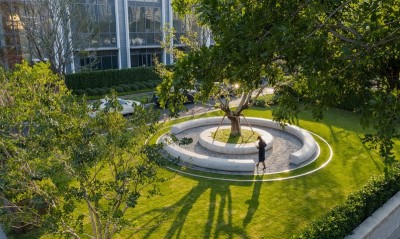
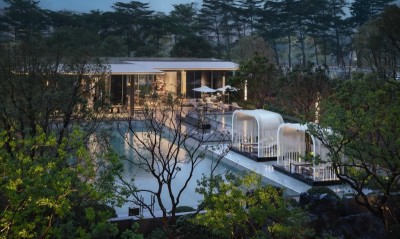
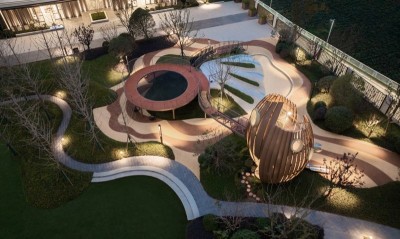
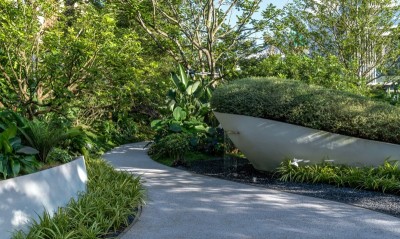
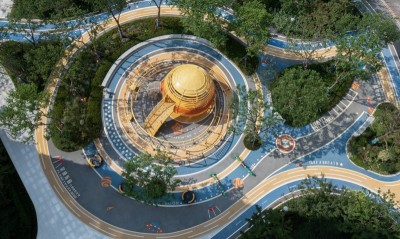
The Hongyang Wanhoufu demonstration garden in Yuhua District, Changsha, takes its cue from the old city's identity as a "mountain-water-island city" on the banks of the Xiang River, where the cloud-capped slopes of Yuelu Mountain and the scholarly lineage of the Yuelu Academy have long shaped local culture. Positioned roughly 2.4 kilometres from the Yuhua District government, the site sits within an already formed road network with convenient bus connections, yet the plot itself is an irregular, almost box-shaped parcel that offers none of the depth one expects from a traditional Chinese courtyard. The landscape architects, the L&A Design team working alongside developer Hongyang Property and architecture by Shanghai Tianhua, therefore faced the task of imposing order on an open, characterless envelope and conjuring a picturesque, almost wild natural world within it. Borrowing the refined idiom of the Yuelu Academy's winding streams and covered walks, the designers layered the sequence as a single narrative that unfolds through three chapters. The opening chapter, "Origins, the ink's natural grace," restages the academy gate as a dense, restrained entry court, using sparsely and densely planted screen walls to separate inside from outside and adopting a deliberate qi-ang (conceal-then-release) tactic before any release. The middle chapter, "Seeking the scene, flowers dance in ink," stretches for nearly fifty metres through a corridor of alternating compression and release, with lush planting that evokes the classic Chinese trope of a winding path leading to seclusion; a small bridge places the visitor in dialogue with the architecture, framed as if within an ink painting. The final chapter, "Narrating from the ink terrace, watching the moon," opens onto a rough-textured stone terrace where, despite an intentionally unrefined surface, fine craft is concealed; here the visitor may sit beneath the sky, alone or in company, and reflect on the legacy of the ancients. The whole project treats classical Chinese scholarly grace not as literal mimicry but as a tonal register, translating the rhythm of the academy garden into a contemporary residential forecourt where a simple arrival becomes a moment of pause.




 Editor's Pick
 Latest Design