Text description provided by the architects
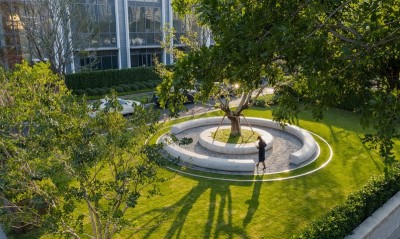
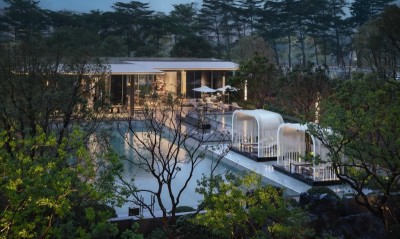
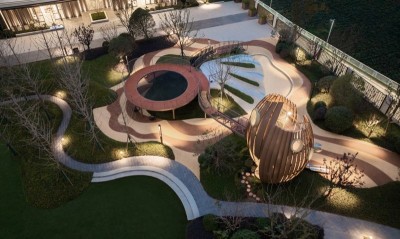
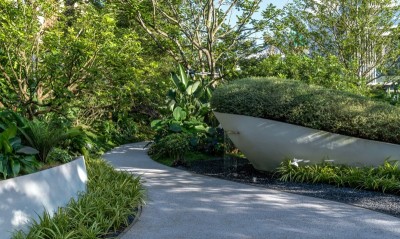
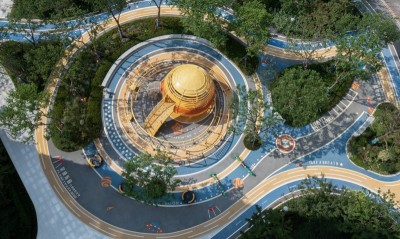
..... As the “top” luxury mansion of Dowell Group, after building up in Chongqing, Chengdu, and Nanjing, the fourth Dowell Riveria is located in Changsha, the land of Xiaoxiang. When the city of mountains and rivers with a thousand years of history meets the Yinchangjiang-it should be a landscape that echos Xiaoxiang’s spirit, and fits the local temperament, delicate and natural, humble luxury and lazy, atmospheric and pure… Trace to the source The project is located in Kaifu District, occupies the Yuehu Lake area of the Changsha Central Cultural District, adjacent to the window of the world to the north and Hunan Radio and Television. It integrates culture, ecology, commerce, transportation, and landscape with a profound cultural heritage and rich natural resources. The site has rich natural resources such as 32,000 m² of indigenous forest, thousand acres of Yuehu Lake Park, and 27,000 m² of wetland park. It is a traditional high-end residential area authorized by the market. In the core area of the city, enjoy excellent landscape resources, so that the project uniquely has a dual landscape of nature and prosperity. The site is lean against a mountain park, which is a piece of pure land in the center of the city. The architecture gains inspiration for the “kiss of the earth” and gently falls on the mountainside to have a dialogue with nature. The high-level humble luxury life is nothing more than the tranquility of the prosperous center. Relying on the excellent and scarce landscape resources and the inheritance of the luxury houses of Yinchangjiang, we let the green of the mountain flowing down and spreading into the park to create an immersive half-mountain secret realm for customers to watch and live. Through the long and quiet tree-lined avenue, the mountains’ outline and buildings are looming. The prosperity of the city and the tranquility of the mountain forest can be freely transferred among 100 meters. The strong sense of returning home increases people’s desire. At the end of the road, a green island is set to welcome guests, and the door is half-covered. The entrance is inherited from the luxury of the Yinchangjiang series. The high-walled courtyard is quiet and solemn, and the refined atmosphere is without losing the fine details. The half down curtains frames the scenery of mountains and rivers. The architecture in the forest becomes part of the painting, together with the landscape, inspiring people’s dreams. Allusions to “Bizuka Mochi”: Huai Su, a local historical celebrity and cursive man in Changsha, became a monk in his childhood and loves calligraphy. Because of the lack of paper (due to the poor family), he planted a cluster of plantain to alternate the paper. He used thousands of plantain leaves at a time. It is said the bald pen became a mound and the ink became a pool. Because the plantains provide green shades like clouds, people called the hut Lvtian An. In the Qing Dynasty, the Lvtian Temple was rebuilt. The word “Yan Quan” was engraved on the back of the temple, where was Huai Su made ink. There is a “pen mound” tower in the right corner, where the bald pens were buried. There is a small pool in the north of the hut. It is the place where Huai Su washed the inkstone so often to make the water dark. The space under the gallery is inspired by “Mochi”, with curved waterline as the pool and stacked stones as the springs. The pine in the courtyard echoes the pins forest behind the demonstration zone. We plan to mimic a micro pine yard garden to reflect the mountain. Also, it is an allusion to “Mochi Yanquan” paying tribute to Huai Su. Passing the gallery, people can hear the sound of the waterfall. The hanging valley offers a Fantastic visual transition for a curved path from the imitation of mountain and water in the courtyard to the wild nature. The landscape views move with people, like being in Taohuayuan. Through the narrow valley, the view becomes more open and shows a wonderland. Sales Office-“the Kiss of the Earth” is at the halfway up the mountain with the forest extending to the site. The waterfall in the front merges with the pine forest, making the architecture part of the landscape and echoing the theme of ‘Fallingwater. ’ The concept of the Luyin Changjing Model District is ‘leading the nature into the garden. ’ We respect the site and local culture, integrate culture and nature, pay tribute to the city and the context, inherit the quality of ‘one city, one Yinchangjing’, and shape a luxury mansion experience in the city center.




 Editor's Pick