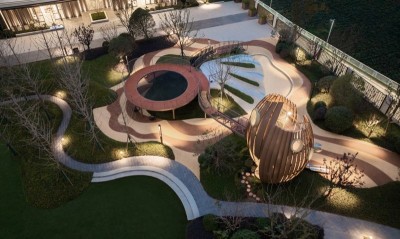
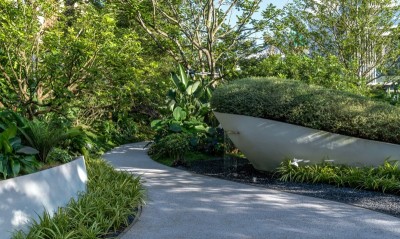
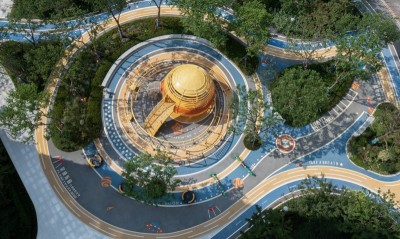
Text description provided by the architects
Can landscape be created from nothing? How to create landscape? The standard answer from contemporary landscape architects is that landscape design should be based on the site and take into account of the spirit of the place and the local culture...... and then you can think about concepts and drawings. The spirit of place has become an impassable golden line for space art which is known as the artistic correctness. In practice, however, such a standard is counterproductive, since most of the residential developments are completely built on old residential sites or wastelands of a new town...... Therefore, in face of a project, we need to accustom ourselves to a blank site, respecting and keeping the precious existences and trying not to create landscapes mechanically. Form, space, spirit, narrative, life, function, etc. all of them are starting points and approaches to landscaping. There is no absolutely correct approach, no eternal validity, and no right or wrong standards of value. The only way to judge a project may lie in whether the design process is reasonable and logical. Conceptual Prototype To create landscapes from nothing, you need to find a prototype on which to base the design from beginning to developing. As for Longfor ·Jade Mansion, Xiamen, the designer takes travel from the landscape culture as the prototype. As an ideal prototype for living and travelling, travel embodies three important landscape ideas: time and space, physical activity and spiritual dwelling, which are the basis and aim of design. Space-time Complex "Travel" actually means returning to the traditional Chinese ideological system to find the lost treasure, which regards landscape as a dynamic and continuous space-time complex rather than a static and framed visual object. In Chinese landscape paintings, the viewer or the person in the painting is just "travelling" on a two-dimensional surface. It is the gesture of travel that contributes to an experience beyond time. From this perspective, travelling among landscapes will allow visitors to experience the ideal lifestyle. And in order to create an ideal living environment, we should first realize that landscape is a complex of multiple dimensions. Physical Activities Another meaning of "travel" is physical activities, including both movement and meditation. In fact, the space-time complex can be understood as people keeping moving in a space and immersed together with time going by. Of course, we can use the fashionable theory of kinesthesias to empower the space. When visitors pass through the landscape space with muscular and neural movements, they can experience a dynamic flow of perceptions from the surroundings. All kinds of sports, such as running, strolling and dancing, allow people to interact with the landscape, and the pace and frequency of body movements even provide a new perspective on the landscape. Spirit of Dwelling The purpose of the space-time complex and the physical activities is to search for a poetic lifestyle among the landscapes.






 Editor's Pick