Text description provided by the architects
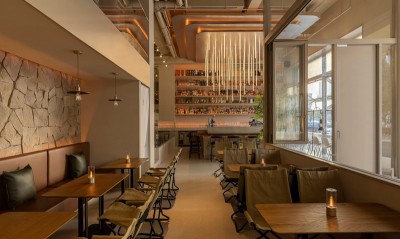
Ao Man Japanese Cuisine in Beijing is rooted in the Japanese culinary pursuit of the ultimate ingredient and taste, an experience that is itself a central strand of Japanese aesthetics: the highest pleasure of food is exchanged from visual image to gustatory touch, and the colours seen as much as the flavours tasted compose an eternal theme of everyday aesthetics. Ao Man is one of Beijing's leading eel-rice restaurants, trained in the Kansai roasting tradition by master griller Ito Tadashi from Mie Prefecture, and from the start it has pursued the freshest ingredients and the most refined taste. The designer uses space to build a here-and-now realm, so that diners do not only taste authentic delicacies but also feel immersed in the original place, culture and people. Following that instinct, the design traces back to Kyoto, the cultural heart of Kansai, drawing imagery from shrines, temples, gardens and painting, and fusing food, culture and design through a shared understanding of the Ao Man brand. The traditional Japanese architectural concept of teioku ichinyo, the unity of garden and house, is applied to the public space: the finely balanced proportion between garden and building is recomposed, and the relationship between viewer and viewed becomes the main spatial thread of a flowing experience. Entering the open lobby, the diner sees a golden installation hanging from the ceiling, like the first sight of the Kinkaku-ji reflected in water; the piece is made with traditional Kyoto hammered-gold craft, its natural texture giving it an antique quality, but it is not a direct cultural citation, only a few minimal abstract lines that emphasise a modern contour, compressing in a few strokes the quiet, reclusive atmosphere of a Kyoto temple.




 Editor's Pick
 Latest Design
 Best Idea